Longevity of the Christmas Advent Building Blocks Calendar
 Maya ChenContributing Editor
October 1, 2026. This analysis evaluates the long-term utility of a reusable building block advent calendar for households seeking to move away from disposable holiday waste. It serves as a technical resource for consumers prioritizing durability over annual novelty.
The Waste Cycle of Seasonal Ephemera
The conventional wisdom says that advent calendars are, by definition, temporary consumables designed for a twenty-four-day lifecycle before meeting a landfill. This cycle is driven by thin-gauge cardboard and single-use plastic trays that provide no structural value once the perforated doors are breached. According to the Environmental Protection Agency (EPA), household waste in the United States increases by approximately 25% between Thanksgiving and New Year's Day, totaling about one million tons of extra trash per week. A significant portion of this is attributed to seasonal packaging that lacks a secondary purpose. While many families attempt a diy building block advent calendar to mitigate this, the underlying issue remains the quality of the components. Most mass-market toy calendars utilize low-density polyethylene that degrades or loses clutch power after a single season of assembly and disassembly. The market has conditioned consumers to expect a product that expires on December 26th, forcing a repurchase the following year. This planned obsolescence is rarely questioned because the price point is kept low enough to mask the long-term cost of replacement. However, when we look at the environmental footprint of producing, shipping, and disposing of these units annually, the logic of the disposable calendar begins to fail under scrutiny.Structural Integrity of Christmas Advent Building Blocks Calendar
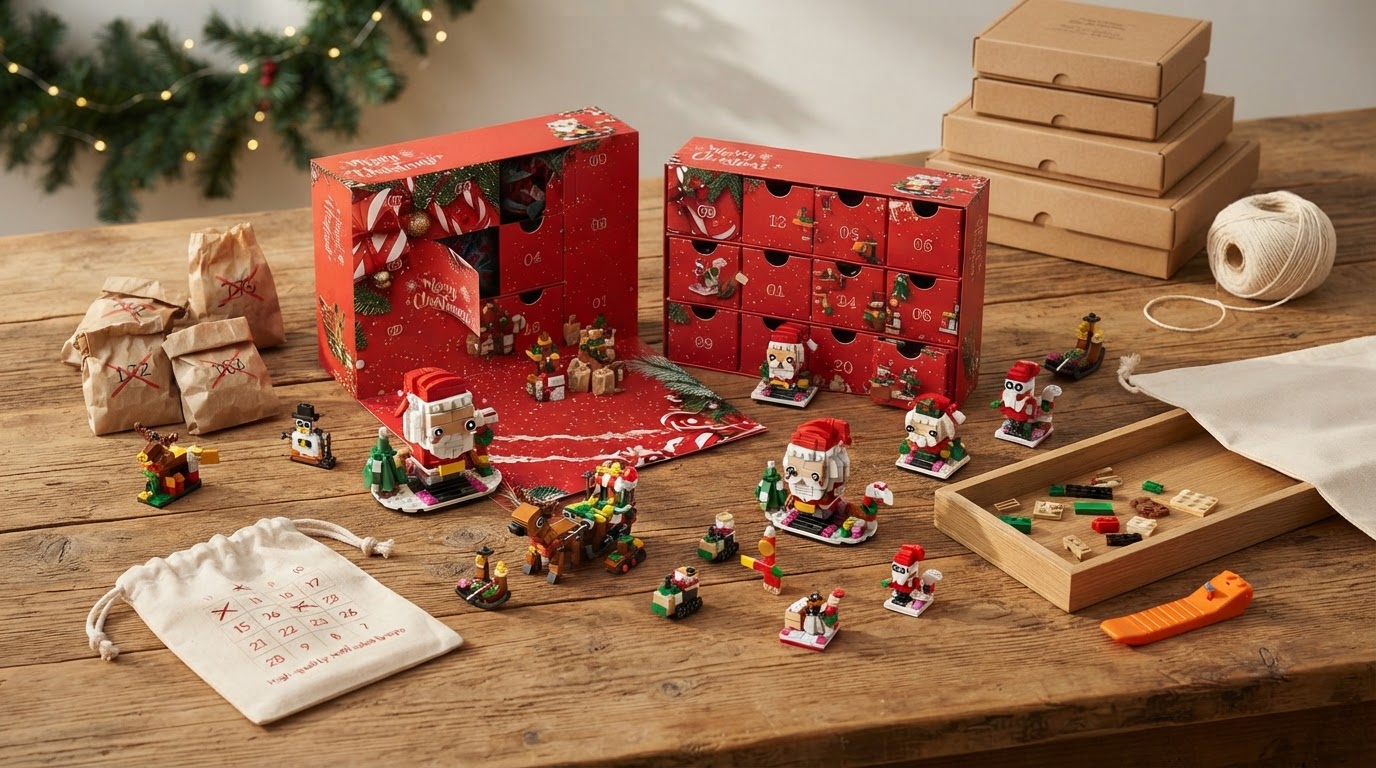
Here's the part nobody talks about: a calendar is only as reusable as its weakest hinge. The Christmas Advent Building Blocks Calendar deviates from the disposable norm by utilizing high-ABS (Acrylonitrile Butadiene Styrene) plastic, which maintains its dimensional stability over hundreds of cycles. Unlike the flimsy cardboard variants, these blocks are designed to be integrated into a permanent collection. The utility here is two-fold: the calendar functions as a countdown mechanism, and the components serve as a collectible building block advent calendar asset that retains value. Run the math: a standard cardboard calendar costs roughly twenty dollars and has a salvage value of zero. In contrast, a high-quality block set maintains its utility for decades. For those who prefer a more hands-on approach, using a diy brick advent calendar kit allows for the rotation of pieces, but the Christmas Advent Building Blocks Calendar provides a standardized foundation that ensures compatibility with existing brick ecosystems. This compatibility is the critical metric for reusability. If the pieces cannot be used outside the context of the December countdown, they are merely plastic waste in a different shape. Because these sets adhere to standard tolerances, they transition from a seasonal decoration to a functional building tool the moment the holiday ends. This prevents the 'January clutter' phenomenon where specialized holiday toys are relegated to storage bins, never to be seen again until they are eventually discarded during a spring cleaning.Framework for Evaluating Multi-Year Utility
When selecting a reusable system, consumers should ignore the aesthetic themes and focus on the mechanical specifications of the bricks. A true reusable system must survive the friction of repeated assembly without losing the 'clutch' that holds the bricks together. If a set fails after three years of use, it has not solved the sustainability problem; it has simply delayed it. I'll change my mind when a biodegradable alternative can match the 0.002mm tolerances required for complex brick builds, but until then, high-grade ABS remains the only viable path for longevity. Use this checklist to determine if a calendar meets the threshold for multi-year investment:- Tolerance Consistency: Ensure blocks are compatible with major brands to allow for expansion and repair.
- Storage Durability: The exterior housing must be constructed from heavy-weight stock or plastic to survive eleven months in storage.
- Part Versatility: The builds included should be useful as standalone models or parts for larger projects.
- Component Density: High-quality sets like the collectible building block advent calendar series offer more pieces per day, increasing the building potential.
- Resale Value: Identify if the specific bricks have a secondary market, which is a hallmark of a diy brick advent calendar kit and professional-grade sets.
- Re-assembly Potential: The instructions must be durable enough to be followed multiple times, preferably available in a digital format to prevent loss.
Shop Christmas Advent Building Blocks Calendar here.
building blocksadvent calendarsustainable toysholiday traditionsreusable gifts